Leadership Clarity During Organisational Change: Why Clarity Matters More Than Certainty
Discover how clarity—not certainty—enables leaders to make confident decisions during transformation and navigate continuous change effectively.
Change rarely fails because leaders lack information. Organisations have never had greater access to information. Dashboards provide real-time performance data. Employee surveys reveal engagement levels. Project updates, financial reports and customer insights arrive continuously. Executive teams are surrounded by more information than any generation of leaders before them.
Yet many organisations still struggle to make confident decisions during transformation. We have all the information we need—but what about clarity?
Certainty vs. Clarity: Understanding the Difference
In times of uncertainty, leaders often respond by seeking more data, more analysis, or more certainty before acting. This is a human way of holding on to what is known and familiar. While understandable, this response can unintentionally increase complexity rather than reduce it.
But are clarity and certainty the same thing? I would argue that certainty is about knowing, while clarity is about understanding what matters next.
Within the BrainShift framework, clarity is one of the Five Human Conditions that enable sustainable transformation. It is not the absence of uncertainty. It is the ability to recognise what deserves attention despite uncertainty. These Human Conditions that shape organisational culture are foundational to how organisations navigate change.
That difference may appear subtle, yet it fundamentally changes how leaders approach organisational transformation.
When certainty becomes the goal, organisations often postpone decisions while searching for one more report. Clarity works differently—it enables leaders to recognise what is sufficiently understood to take the next meaningful step while remaining open to adjusting as new information emerges.
In a world where change has become continuous rather than episodic, this capability becomes increasingly valuable because organisations rarely have the luxury of waiting until uncertainty has disappeared. The bigger question is how that distinction changes the way leaders approach transformation.
The Hidden Cost of Complexity
Transformation introduces competing priorities, changing assumptions and continuous uncertainty. Every function sees the organisation through a different lens. Finance focuses on financial performance. Operations focus on delivery. HR focuses on people. Technology focuses on systems.
Each perspective is valuable, and together they provide a fuller picture. The challenge begins when these perspectives remain disconnected. Often, leaders find themselves discussing the same transformation while operating from entirely different interpretations of reality.
I have experienced this repeatedly while facilitating executive team discussions. Everyone around the table is committed to achieving the same outcome, yet the conversation gradually reveals that each leader is interpreting the situation through the perspective of their own responsibility. Finance naturally notices financial exposure. HR recognises leadership capability and organisational readiness. Operations focuses on execution, while technology sees dependencies and system limitations. None of these perspectives are wrong. In fact, each of them is essential.
The challenge is that organisations often mistake multiple perspectives for shared understanding. Without creating a common interpretation first, decisions are built on different versions of the same reality. The result shows up as conflict, while it is mainly confusion.
Meetings become longer. Decisions become slower. Teams leave conversations believing they agreed, only to discover later that they understood different things. When shared understanding remains concentrated in a few senior leaders, individual capability can become a dependency rather than organisational capacity.
Research suggests that even when people believe they completely agree, they often share only a surprisingly small proportion of the same understanding. The visible problem appears to be poor execution. The hidden problem is insufficient clarity. This is why executive team alignment starts with shared understanding—not just agreement on decisions.
Why the Brain Seeks Certainty
Uncertainty places demands on the human brain. When the future feels unclear, how often do you find yourself trying to make sense of it by searching for a logical explanation? Our natural instinct is to reduce ambiguity as quickly as possible. We look for definitive answers, familiar patterns and predictable outcomes because uncertainty requires more cognitive effort than certainty.
Leaders who wait until every answer is available often discover they have simply delayed the decisions that matter most. The challenge is therefore not to eliminate uncertainty. It is to remain capable of thinking clearly within it. Understanding decision quality under pressure and what happens in the brain during high-stakes moments becomes essential.
We seek certainty because the brain is biologically wired to reduce uncertainty. Uncertainty is interpreted as a potential threat, increasing cognitive load and emotional discomfort. In response, the brain immediately begins searching for patterns that restore a sense of predictability, even if the explanation we create is incomplete.
This process is not simply about reducing stress. It is also about preserving our existing mental models. The brain continuously compares new information with previous experiences to make the world easier to navigate. Most of the time this serves us well. During organisational transformation, however, previous experience is not always the best guide for understanding what is happening now.
As a result, two experienced leaders can observe exactly the same situation while constructing entirely different interpretations of what deserves attention.
The difference lies not in the information they receive, but in the assumptions through which they interpret it. This is where many organisations unintentionally create additional complexity. More meetings. More reporting. More governance. More information.
These initiatives are usually introduced with good intentions. They are designed to create confidence, coordination and control. Yet unless they help people create a shared understanding of what they are seeing, they risk producing the opposite effect. Instead of reducing uncertainty, they simply produce more noise. This is particularly true during leadership under pressure, when good decisions become difficult.
Clarity as a Leadership Capability
Many people think clarity means having the right answers. The BrainShift framework views clarity differently. Clarity is not the absence of complexity or the ability to simplify difficult situations. It is the capability to distinguish what matters most when many things appear equally important.
It allows leaders to recognise patterns instead of becoming overwhelmed by details, to connect observations across functions and to challenge assumptions before conclusions become decisions. In this sense, clarity shifts from being a communication skill to becoming a thinking capability. Research in neuroscience shows that state beats strategy—your internal state determines the quality of your thinking far more than your strategic knowledge.
The quality of an organisation's decisions rarely exceeds the quality of the thinking that produces them. Clarity therefore becomes more than an individual leadership skill. It becomes an organisational capability that shapes how executive teams make sense of reality together.
When leaders develop a shared understanding before moving into action, alignment becomes easier because it is built on common meaning rather than individual interpretation.
From Trust to Clarity
In the article Organisational Trust: Why It Determines Transformation Success, we explored trust as the strategic capability that allows reality to move through an organisation.
Trust answers one question: Can reality reach the people making decisions?
Clarity answers the next: Can leaders make sense of the reality they receive?
Without trust, important information never reaches leadership. Without clarity, leaders receive the information but struggle to interpret it. Transformation requires both. Reality must be visible. It must also become meaningful. Psychological safety during change is what enables people to surface reality in the first place.
Trust and clarity therefore reinforce one another. Trust allows reality to surface. Clarity enables leaders to understand what that reality requires of them. One without the other leaves organisations vulnerable—either because they are making decisions without enough information or because they are unable to make sense of the information they already have.
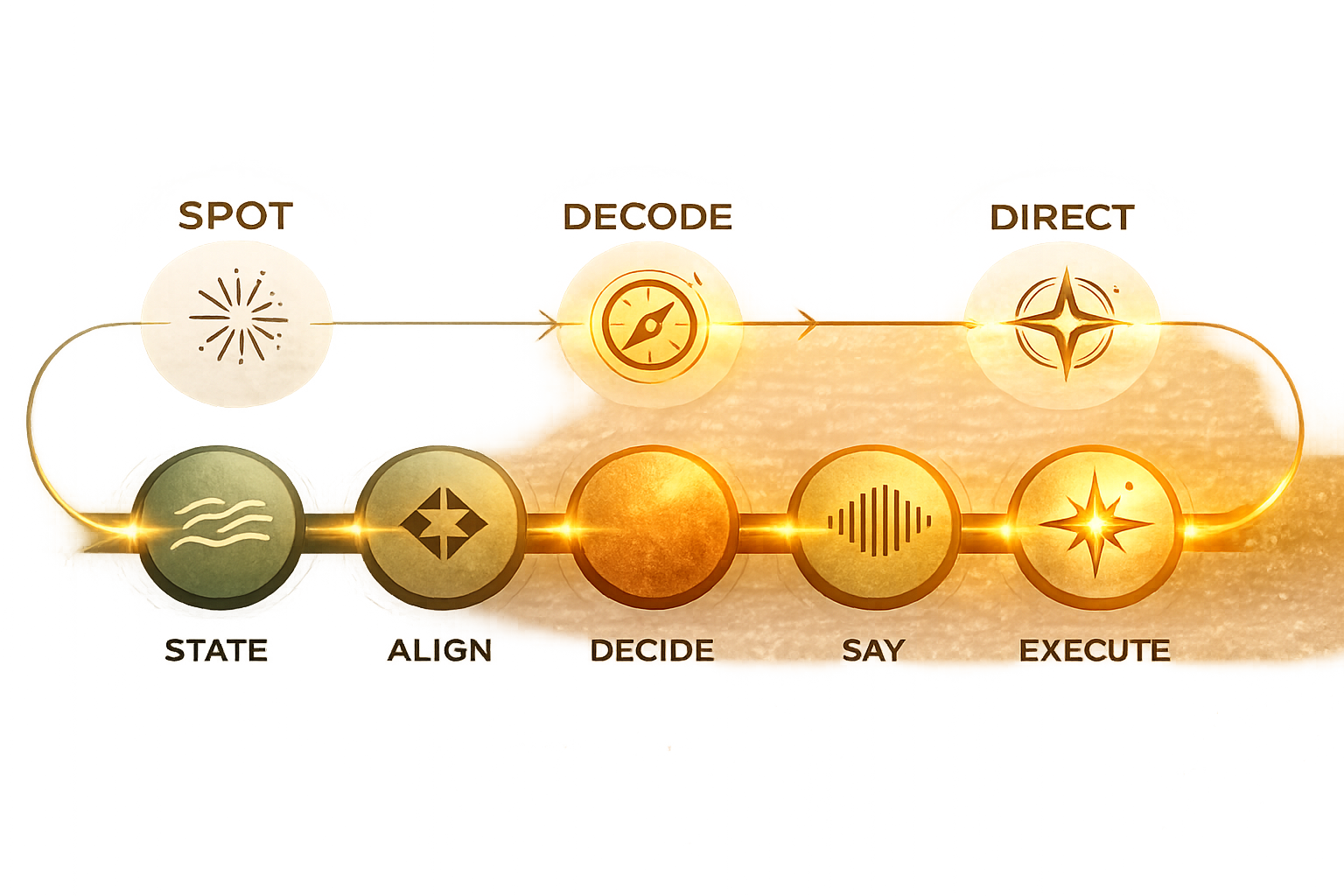
The Clarity Chain
This is where The Clarity Chain becomes essential. The Clarity Chain did not emerge from the assumption that leaders needed another framework. It emerged from repeatedly observing that organisations rarely struggle because they lack intelligent people or committed leadership teams. More often, they struggle because they lack a shared process for making sense of complexity before making decisions.
Conversations move quickly towards solutions, while too little time is spent understanding whether everyone is actually seeing the same situation. That observation became the starting point for The Clarity Chain. Understanding what organisational transformation really is from a human perspective is foundational to this work.
Rather than viewing clarity as something leaders either have or lack, The Clarity Chain provides a practical leadership process for making sense of complexity, developing shared understanding and translating that understanding into coordinated action.
At its core, the process is built around three recurring leadership loops—Spot, Decode and Direct—that help leaders continually interpret changing conditions rather than reacting to isolated events.
Rather than following a linear process, leaders continually move between these three loops as new information emerges, assumptions evolve and organisational conditions change. In doing so, clarity becomes something that is continually created rather than something leaders are expected to possess from the outset.
As executive teams strengthen their ability to move through these cycles together, discussions become more focused, priorities become clearer and alignment becomes a natural consequence of shared understanding rather than an objective organisations continually have to enforce.
→ Explore The Clarity Chain and its five-step leadership process.
Clarity Accelerates Transformation
Organisations often associate speed with making faster decisions. In practice, sustainable speed comes from making clearer decisions. When leaders have a shared understanding of what matters, they spend less time revisiting conversations and more time moving the organisation forward.
Decisions become more consistent because they are grounded in a common interpretation of reality rather than individual assumptions. This changes the way transformation unfolds. Instead of repeatedly stopping to resolve misunderstandings, executive teams can focus their attention on the challenges that genuinely require discussion.
Priorities become easier to communicate because they are understood before they are communicated. Teams no longer need constant reassurance or approval because they understand not only what has been decided, but why it matters. This is particularly important when people resist change at work—clarity about the why helps overcome resistance.
Clarity therefore creates a different kind of speed. It is not the speed that comes from reacting quickly. It is the speed that emerges when people no longer have to pause and reinterpret the organisation's direction every time circumstances change.
This is where clarity creates more than confidence. It creates momentum. Not because uncertainty has disappeared, but because leaders understand what deserves their attention despite uncertainty.
Over time, that momentum becomes one of the organisation's greatest strategic advantages. Rather than constantly recovering from confusion, energy is directed towards learning, adapting and executing. Decisions build on one another instead of repeatedly replacing one another, allowing transformation to develop with greater consistency and resilience.
Leading Through What Cannot Yet Be Seen
Transformation is often approached as something that can be planned, managed and executed through better strategy, better processes or better information. Yet the organisations that navigate change most effectively rarely succeed because they know more than everyone else.
They succeed because they develop a greater capacity to make sense of what they are experiencing while it is still unfolding. This is where leadership changes. The challenge is no longer to eliminate uncertainty before acting. It is to help people understand enough of the present to move forward together. Presence under pressure becomes the foundation for this kind of leadership.
Perhaps that is why clarity has become such a critical leadership capability. It is also why BrainShift treats clarity as a condition rather than a competency. Competencies belong to individuals. Conditions shape how people think, decide and perform together.
Not because it removes complexity. But because it allows people to navigate complexity without becoming overwhelmed by it.
Before asking whether your organisation has enough information, consider a different question: If every leader in your executive team described your organisation's greatest challenge today, would they describe the same reality—or reveal how differently they understand it?
Because transformation rarely begins with better answers. The organisations that thrive through transformation are not those that eliminate uncertainty first. They are the ones that continually strengthen their ability to Spot what is changing, Decode what it means and Direct collective action before complexity turns into confusion. This is the essence of leadership clarity during organisational change.
Ready to Build Clarity in Your Organisation?
Continue the Conversation
If your executive team is navigating organisational transformation and wants to strengthen leadership clarity, decision-making and alignment, a Discovery Call is the best place to start.