That is one of the more uncomfortable truths about leadership burnout. It does not always begin with visible collapse. It often begins with adaptation — quiet, intelligent adaptation. The kind that helps a leader get through another quarter, another reorganization, another difficult board meeting, another round of uncertainty.
At first, nothing looks particularly wrong. Decisions are still made. Meetings still happen. The team still delivers. But the quality of energy changes. Curiosity narrows. Small issues feel heavier than they should. The leader still functions, but with less range.
The Subtle Shift: When Range Contracts
One of the most important early signals is a shift in how a person shows up.
Not necessarily a dramatic change. More often, a subtle narrowing.
Someone who has usually been firm on quality may become more passive, more detached, or less precise than usual. Someone who has been open-minded and exploratory may become narrow, impatient, or unusually focused on control. A leader known for strategic, long-term thinking may find themselves squeezed into delivery mode — more task-driven, more reactive, less able to hold the wider horizon.
That shift matters.
Because burnout often shows itself first not as a breakdown, but as a change in expression. The person is still there, but their range has contracted.
A forest under stress does not turn brown overnight. It can look alive long after the roots have stopped receiving what they need. Leadership burnout often starts in that hidden place. Not as weakness, but as information.

Burnout Is Not Just a Workload Issue
The World Health Organization defines burnout as an occupational phenomenon caused by chronic workplace stress that has not been successfully managed. It describes three dimensions: exhaustion, mental distance or cynicism toward work, and reduced professional efficacy. WHO also makes an important distinction: burnout belongs to the work context. It is not simply a general word for being tired.
That distinction matters because if burnout is treated only as an individual problem, the response becomes too small. Rest more. Set boundaries. Delegate. Take time off. All of these may be necessary, and none of them should be dismissed. But they do not answer the organizational question: what has the system been asking people to carry?
In my experience, burnout risk often increases when high capacity becomes normalized. The person who can absorb complexity receives more of it. The team that moves fast is expected to keep accelerating. The leader who can hold tension becomes the place where unresolved tension collects. At first, this looks like trust. Later, it becomes dependence. Eventually, it may become invisible.
That is where the risk begins to deepen. Not because people are fragile, but because the organization has started to confuse endurance with health.
Burnout risk increases when high capacity becomes normalized. The organization confuses endurance with health.
What Changes Before Anyone Names It
Burnout does not always show up first as exhaustion. Sometimes it appears as reduced flexibility, less patience with ambiguity, less interest in dissent, more urgency around small matters, a stronger need for control, or a quiet loss of humour. These shifts are easy to misread as personality changes or leadership style, but they are often state changes.
This distinction is important.
When we say that burnout can create a personality shift, we do not mean that the person has become someone else. More often, the nervous system has reduced access to the person's full leadership range. The strategic thinker becomes operationally trapped. The curious leader becomes defensive. The quality-driven leader becomes inconsistent or detached. The warm leader becomes distant. The visionary becomes absorbed by the next deadline.
What I have noticed is that this shift is often visible to others before the person can fully name it in themselves. They may explain it as "a busy period," "a lot going on," or "just needing to get through this phase." And sometimes that is true. But when the shift persists, it deserves attention.
One early signal of burnout risk is not only how people behave, but what kind of language the organization begins to normalize. When urgency becomes the default tone, the nervous system eventually starts treating ordinary work as threat. This is the reality of leadership under pressure — the body responds to sustained urgency as if it were sustained threat.
This is where neuroscience becomes useful, not as academic decoration, but as a practical map. Under sustained pressure, the nervous system prioritizes protection. Attention narrows. The brain reaches for what is familiar. Complex thinking becomes harder. The body prepares to act, defend, avoid or shut down.
In a workplace, this can look ordinary. A leader moves too quickly to solution. A team avoids the real issue until it becomes expensive. A meeting sounds aligned because no one wants to test the silence. A decision is made, but not really metabolized. Nothing dramatic has happened, and yet the system has shifted.
This is why BrainShift begins with state. Not because state replaces strategy, but because state shapes how strategy is perceived, communicated and executed. A leader's pace, tone, facial expression and response to pressure all become signals. People read these signals quickly, often before they understand what they have read.
That is nervous system regulation in leadership. Not a private wellness practice, but a condition that affects judgment, trust and the quality of collective thinking.

When Delivery Mode Replaces Strategic Capacity
One pattern I often see is that burnout pulls leaders away from the level of thinking where they create the most value.
For some, that means moving away from quality, nuance and craft into a flatter form of execution. For others, it means moving away from openness, creativity and strategic perspective into control, urgency and short-term delivery. The shift can look productive from the outside, because more tasks may be completed. But the deeper leadership capacity is reduced.
This is a difficult pattern to catch because delivery mode is often rewarded.
It looks responsible. It looks committed. It looks useful.
But when a leader who is naturally visionary, strategic and long-term oriented starts squeezing themselves into constant delivery, something important is being lost. The organization may gain short-term movement while losing perspective, timing and direction.
That was also a pattern I recognized in myself. I was not simply working more. I was becoming narrower. I was pressing myself into a firmer, more task-driven version of leadership, while the strategic, visionary and long-term thinking part of me had less and less space.
This is often how burnout hides. It does not always make people stop. Sometimes it makes them over-function in a smaller version of themselves.
When Crisis Becomes the Operating Rhythm
One thing I noticed after the pandemic was how easily crisis language became normalized. Many organizations moved from one urgent meeting to the next. Supply issues, shifting conditions, operational interruptions and constant uncertainty created a rhythm where "crisis meetings" became almost daily.
But if you have crisis meetings every day for six to twelve months, they are no longer crisis meetings. They have become the way work is organized.
That matters because the word crisis does something to the nervous system. It narrows attention. It signals threat. It makes people more defensive, more reactive and less able to think broadly. The intention may be to create urgency, but the effect can be the opposite: people start protecting, proving, reacting and trying to be important in the room, rather than thinking clearly about what the system actually needs.
This is not only semantics. Language changes state.
When everything is called a crisis, the organization can lose access to perspective. The focus becomes short, the tone becomes compressed, and the body prepares for survival. In that state, people may work hard, but they rarely think at their best.
Sometimes the first leadership move is simply to rename what is happening.
Not to soften reality. But to widen the field.
Instead of calling every disruption a crisis, leaders can ask: Is this a decision point? A recovery point? A learning point? A coordination point? An opportunity to redesign how we work?
Those words create a different internal posture. They move the system from defence toward direction.

When Belonging Hides Inside Ambition
Leadership burnout is often described through workload. Workload matters, but it rarely explains the whole pattern. One deeper driver is belonging.
In the Apple Podcasts episode "Midlife Burnout and the Nervous System," where I was the guest discussing these themes, we explored how overwork, busyness and the need to belong are closely connected to burnout. We also discussed how burnout can affect energy, memory, relationships, leadership and home life, and why many leaders need to shift from operating through the ego to working with the nervous system.
That is a precise distinction. In senior roles, belonging is often tied to usefulness. The person who delivers is trusted. The person who solves is included. The person who remains available is seen as committed. A quiet equation begins to form: if I deliver, I am valuable; if I am valuable, I belong; if I belong, I am safe.
This is not always conscious, and it is not always unhealthy. In many careers, this pattern is rewarded early and repeatedly. It can build competence, reputation and influence. But every successful pattern has a cost when it becomes automatic.
One pattern I often see is that organizations speak about sustainability while still rewarding rescue behaviour. A leadership team may ask for strategic thinking while filling every space with urgency. A company may encourage recovery while celebrating the people who are always available. The contradiction is subtle, but the nervous system notices. This is often where people resist change at work — not because they oppose the change itself, but because the system's mixed signals create confusion and protective responses.
Over time, ambition becomes harder to separate from threat. The organization may still call it commitment. The body may experience it as survival.
Psychological Safety Is Practiced Under Pressure
Psychological safety is now a familiar phrase in leadership development. That is helpful, but it also creates a risk. Familiar language can become too easy to agree with and too difficult to live.
Psychological safety is not created by telling people they may speak openly. It is created through repeated evidence that honesty does not lead to punishment, dismissal, embarrassment or relational cost.
Hanna Curman positions BrainShift as a neuroscience-based leadership development approach that connects psychological safety at work, trust, alignment and execution capacity. That connection matters because psychological safety is not simply about comfort. It is about whether relevant truth can move through the organization early enough to improve decisions.
This is where leadership burnout and psychological safety meet. A tired leader may still want honesty. A pressured executive team may still value transparency. But wanting truth and being able to receive it well under pressure are not the same thing.
What I have noticed is that organizations learn this difference through repetition. If challenge is met with defensiveness, people learn. If bad news creates irritation, people learn. If uncertainty is treated as incompetence, people learn. If speed is rewarded more consistently than sense-making, people learn.
Usually not from one event, but from repeated signals. The body listens to patterns, not posters.
The body listens to patterns, not posters. Trust is built through consistency between what is said and what is done.
Where The Clarity Chain Becomes Practical
Burnout is often treated as an energy problem. In leadership systems, it is frequently a clarity problem first. This is where The Clarity Chain becomes useful.
BrainShift is described as translating neuroscience into operational clarity, helping leadership teams see the invisible patterns that drive behaviour and culture. The Clarity Chain includes assessing the current state, building neurological awareness, designing for the brain and embedding change so that it can be sustained.
The practical point is simple: many organizations try to repair problems too late. They see poor execution and ask for more follow-up. They see disengagement and ask for more motivation. They see stress and ask for better self-management. They see conflict and ask for better communication. Sometimes that helps, but often the break happened earlier.
The state was not noticed. The tension was not decoded. The trade-off was not made explicit. The decision was not clean enough. The communication sounded clearer than the reality actually was. Then the team was asked to execute.
That creates nervous system load. People can work hard when the direction is clear, the boundaries are honest and the priorities make sense. What drains energy is constant interpretation. What matters most now? Is this still the priority? Can I raise the risk? Who owns the decision? What happens if we slow down? Is disagreement safe here?
These questions do not only occupy the mind. They occupy the body. They keep people scanning. When that scanning continues for long enough, the symptoms may appear as burnout, disengagement or resistance, but the root often sits earlier in the chain.
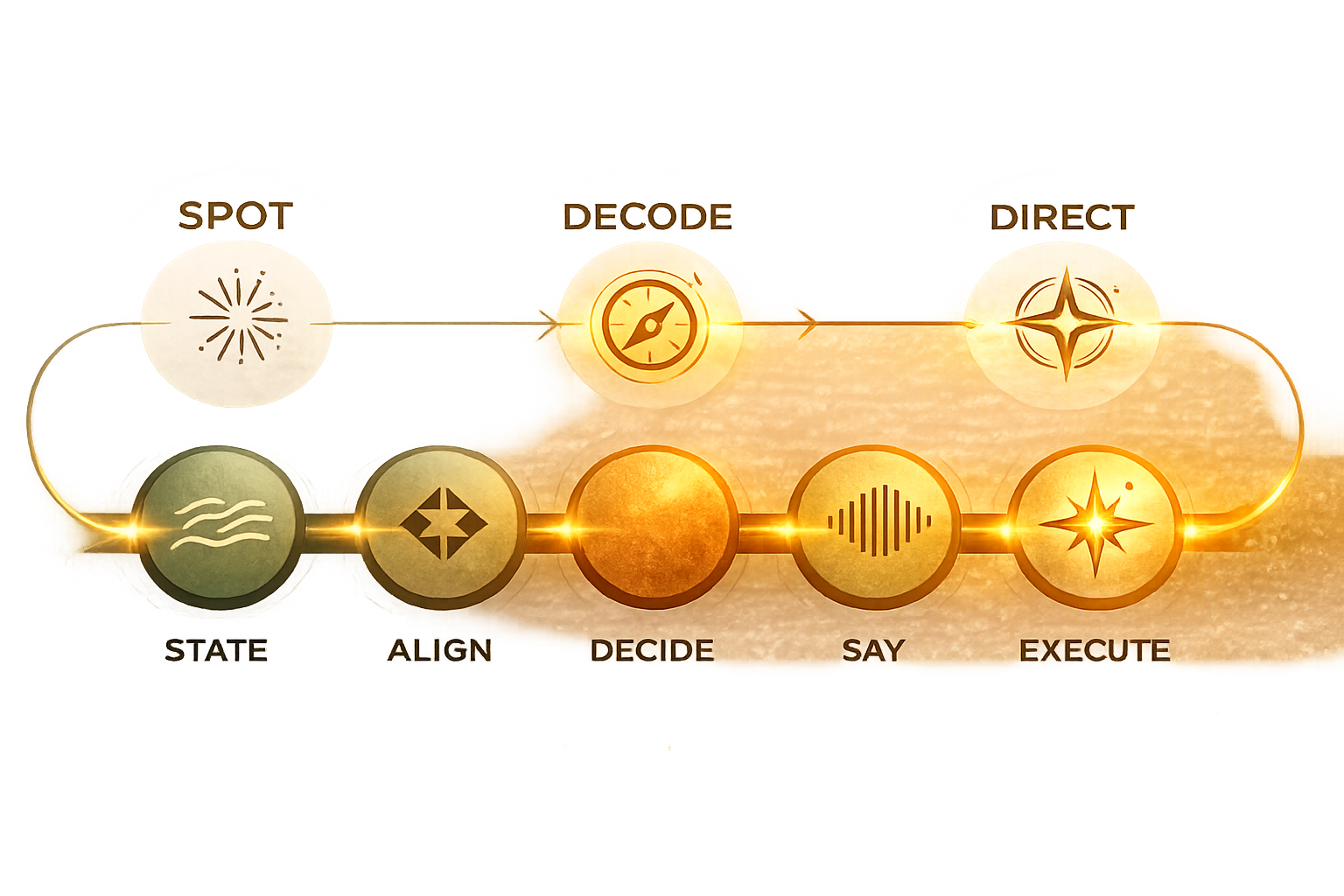
For a full description of the Clarity Chain...
Why This Becomes a Business Issue
Burnout has a human cost before it has a financial one. That should be enough. Still, organizations need to understand what is lost when people operate in sustained depletion. Gallup's 2026 State of the Global Workplace report found that only 20% of employees worldwide were engaged in 2025 and estimated that low engagement cost the global economy $10 trillion in lost productivity.
Low engagement and burnout are not identical, but they often grow in similar soil: unclear expectations, low agency, weak manager support, unresolved tension, poor recovery and too much work disconnected from meaning.
The cost is not only absence or turnover. It is reduced judgment, slower learning, less initiative, more carefulness, fewer early warnings and less willingness to say the thing that would have saved time three months later. The work may continue, but the discretionary intelligence of the system decreases.
That is one of the least visible forms of waste in organizations. The output remains, but the quality of attention declines. And leadership depends on attention.
Recovery Speed Matters More Than Constant Calm
Sustainable leadership is sometimes misunderstood as the absence of pressure. That is not realistic. Leadership involves pressure. Transformation involves uncertainty. Growth creates friction. Strategic decisions involve loss as well as possibility.
The more useful question is not how to remove all pressure. It is how quickly the leader, the team and the organization can return to clarity when pressure pulls them away.
This is where nervous system regulation becomes practical. A regulated leader is not calm all the time. That would be an impossible and unhelpful standard. A regulated leader can notice the shift before acting from it: the tightening around challenge, the impulse to control, the wish to avoid, the urgency to decide too quickly, the need to prove competence, or the interpretation of silence as resistance.
A regulated team is not free from tension either. It is able to work with tension without moving immediately into protection, blame or withdrawal. In an orchestra, the value is not that every instrument stays perfectly tuned forever. The value is that the musicians hear drift early and adjust before the music loses coherence.
Leadership requires the same listening. Not perfection. Return.
What Leaders Can Begin to Change
Simple advice can be misleading here. Some burnout situations require rest. Some require role redesign. Some require sharper priorities. Some require a more honest strategy. Some require work to stop.
Still, a few practices consistently matter.
First, notice state before content. Before an important conversation, ask: what state is entering the room with me? Rushed. Defensive. Curious. Clear. Already convinced. Over-responsible. Avoidant. This is not self-focus. It is preparation.
Second, notice the shift in leadership expression. Am I becoming more narrow than usual? More passive? More rigid? More detached? More operational than strategic? More focused on delivery than direction? This is often one of the most practical starting points, because the shift in expression is easier to observe than burnout itself.
Third, clarify before accelerating. Under pressure, many organizations increase pace before they increase clarity. That usually creates rework. It also creates emotional friction. A better move is to pause long enough to define the next clean step: what is the decision, what is the trade-off, what is not included, who owns the next move and what are we asking people to stop doing?
Fourth, be precise with language. If everything is called a crisis, people will eventually organize themselves around threat. Leaders do not need to make situations sound easier than they are, but they do need to choose words that help people think. A disruption may be a decision point, a learning point, a coordination point or an opportunity to redesign. The word matters because the state matters.
Fifth, separate commitment from overextension. Cultures learn from what leaders reward. If the people who rescue, absorb and over-function are praised most consistently, others will copy that pattern. The organization may unintentionally train burnout into its definition of excellence.
Sixth, make the undiscussable discussable earlier. Burnout grows in the space between what people experience and what the organization can talk about. Where are we pretending to be aligned? Which decision keeps returning because it was never truly made? What is costing more energy than it should? Where has silence been mistaken for agreement?
These are mature questions, not comfortable ones. But they are often less costly than avoidance.
Why This Matters Now
The conditions around leadership have changed. AI, automation, hybrid work, economic pressure and shifting expectations have increased the cognitive and emotional load on leaders. BrainShift is described as a neuroscience-based methodology for sustainable leadership and organizational growth, combining brain research, behavioural psychology and change management to help leaders and teams shift patterns and create lasting impact.
This is why the best neuroscience coach is not simply someone who explains the brain. The value lies in understanding how neuroscience coaching helps leaders perform under pressure — recognizing what happens in real time: when uncertainty narrows perception, when a trigger becomes a decision, when ambiguity becomes exhaustion, when psychological safety weakens through small repeated signals, and when belonging quietly shapes performance patterns.
This work requires evidence. It also requires judgment, because most leaders are not trying to create unhealthy systems. Most are trying to succeed inside conditions that have become more demanding than the old ways of leading can hold.
That is the tension, and it deserves to be taken seriously.
How to Read the Signals Earlier
BrainShift offers a way to read the signals earlier. The nervous system shows where pressure is accumulating. Triggers show where protection patterns are active. The Clarity Chain shows where state, alignment, decision-making, communication and execution have lost connection. Psychological safety shows whether truth can move early enough to protect performance.
One of the earliest signals may be the simplest to observe: a shift in how a person leads. Not a failure of character, but a contraction of range. The visionary becomes operational. The open-minded leader becomes narrow. The quality-driven leader becomes inconsistent or detached. These shifts are not proof of burnout, but they are signals worth listening to.
The same is true for language. When crisis becomes everyday vocabulary, the body starts preparing for threat even when the work requires perspective. Leaders shape reality not only through decisions, but through the words they use to define the moment.
Burnout is not only a personal collapse. It is a signal that something important has been unheard for too long.
Conclusion: The Body Tells the Truth Early
Burnout is not the opposite of ambition. It is often what happens when ambition loses contact with recovery, clarity and biological reality.
The signal is there before the collapse. The narrowing comes before the shutdown. The shift in expression precedes the crisis. The nervous system knows before the mind catches up.
The question is whether the organization is listening.
The leadership task is not to remove all pressure. It is to build systems where pressure can be met with clarity, recovery and trust. That is what allows organizations to keep moving without slowly draining the people who make movement possible.
When burnout is understood as a leadership signal, it becomes an opportunity to redesign how the system works — not as a crisis to manage, but as information to act on.
Ready to understand burnout as a leadership signal?
If you recognize these patterns in yourself or your leadership team, let's explore how neuroscience-based coaching can help you build a system where high performance is sustainable, where truth reaches the table early, and where recovery is part of the strategy.
Name*Email*Phone*Company* I consent to my information being stored according to the privacy policy
Captcha
Submit