Neuroscience Leadership: Why State Drives Strategy
When pressure rises, most executive teams talk more about strategy. But strategy is executed by human beings under pressure. That is where neuroscience becomes business-critical.
When pressure rises, most executive teams talk more about strategy.
They revisit the plan. Tighten reporting. Increase meeting cadence. Ask for clearer ownership. Push harder on execution. All of this may be necessary. But it is not always sufficient.
Because strategy is not executed by PowerPoint decks, OKRs or transformation roadmaps. Strategy is executed by human beings under pressure.
That is where neuroscience becomes business-critical
Neuroscience helps us understand what happens to decision-making, communication and behavior when leaders and teams operate under uncertainty. It explains why smart people become defensive, why strong teams become fragmented, why transformation loses momentum, and why clarity disappears exactly when it is needed most.
This is the core BrainShift principle:
Pressure is a state — not a strategy.
If leaders treat pressure as a strategy, they will often add more activity. More meetings. More follow-up. More urgency. More control.
But if pressure is understood as a state, the question changes.
Not: "How do we push harder?"
But: "What state are we leading from — and what is that state creating in the system?"

Why neuroscience belongs in executive leadership
Neuroscience is often misunderstood in leadership contexts. It is either reduced to brain facts, or pulled into the world of wellbeing and personal development. That makes it too small.
For executive leadership, neuroscience should be used to improve decision quality, strategic clarity and transformation capability.
When an organization is under pressure, the nervous system does not behave neutrally. The human brain is designed to detect threat faster than it processes logic. When uncertainty rises, leaders may narrow their focus, rely on familiar patterns, avoid difficult conversations or over-control the details. These reactions are not character flaws. They are biological responses.
The problem is that biological responses become organizational signals.
- • A CEO who moves into urgency may unintentionally create fear.
- • A COO who moves into control may reduce ownership.
- • A CHRO who avoids conflict may protect comfort at the cost of clarity.
- • A transformation leader who becomes too rational may lose emotional buy-in.
In other words, the leader's internal state does not stay internal. It travels through decisions, communication, tone, timing, priorities and behavior.
That is why neuroscience leadership development must be connected to business reality. It is not about helping leaders feel calm for the sake of calm. It is about helping them lead with higher precision when complexity increases.
State drives decisions
Every decision is made from a state.
A leader in a grounded state can usually access wider perspective, better listening, clearer prioritization and more adaptive thinking. A leader in a defensive state may still be intelligent and experienced, but the decision field becomes narrower.
Under pressure, the brain tends to prioritize safety, speed and control. That can be useful in acute crisis. But most organizational transformation is not an acute emergency. It is a prolonged period of ambiguity, competing priorities and emotional friction.
If leaders stay in survival-based decision-making for too long, several things happen.
- • They may confuse speed with progress.
- • They may mistake resistance for incompetence.
- • They may communicate decisions before meaning has been created.
- • They may push execution before alignment is strong enough.
- • They may ask for ownership while signaling distrust.
This is how transformation fatigue begins. Not because people are weak. Not because the strategy is always wrong. But because the organization is asked to execute from a state that cannot sustain quality movement.
BrainShift connects this chain clearly:
State → decision quality → leadership behavior → culture and structure → organizational result
This chain matters. Because many organizations try to solve cultural or execution problems too late in the chain. They redesign structures, introduce new processes, or launch engagement initiatives without addressing the leadership state that keeps recreating the same patterns.

Strategic presence is not mindfulness
Many leaders hear the word presence and assume it belongs to mindfulness, wellbeing or soft leadership. That is not the BrainShift position.
Strategic presence is not about being relaxed. It is not about being liked. It is not about slowing everything down.
Strategic presence is the capacity to remain clear, steady and adaptive under pressure.
It is the ability to stay connected to the bigger picture when the room becomes tense. To make decisions without being hijacked by urgency. To communicate direction without creating unnecessary threat. To hold friction without collapsing into avoidance or dominance.
In executive leadership, presence is not a personal quality. It is an operational capacity. Presence Under Pressure is what separates leaders who fragment their teams under stress from those who hold clarity and coherence.
A present leader changes the room.
- • People think more clearly.
- • Conflict becomes more usable.
- • Decision-making becomes less reactive.
- • Priorities become easier to understand.
- • Trust increases because signals become more coherent.
This is where brain-based leadership coaching becomes strategic support. Not coaching as emotional processing. Not coaching as performance cheerleading. But coaching as capability building for leaders who need to operate with clarity inside pressure.
For PE-owned companies, industrial transformation, founder-led scale-ups and executive teams navigating AI-driven change, this is not optional. The speed of transformation is increasingly limited not by strategy, but by human capacity to absorb, interpret and execute change without fragmenting.
The hidden cost of reactive leadership
Reactive leadership is not always dramatic. It often looks productive.
It looks like fast decisions, direct communication, intense follow-up and high standards. But underneath, the system may be losing intelligence.
- • People stop challenging assumptions.
- • Teams wait for instructions.
- • Middle managers become translators of executive tension.
- • Decision rights become unclear.
- • Meetings become places for reporting rather than thinking.
- • Culture becomes polite on the surface and resistant underneath.
This is why executives often experience a strange gap: everyone seems busy, but momentum is low.
The issue is not always effort. It is coherence.
Neuroscience helps leaders understand that organizations move at the speed of perceived safety and clarity. Psychological safety at work is not about comfort. It is about whether people can speak, think, challenge and act without unnecessary social threat.
In a transformation context, this matters directly. If people do not feel safe enough to name risks, challenge unclear assumptions or admit uncertainty, the organization loses access to critical intelligence.
That intelligence is often the difference between transformation theatre and transformation impact.
From individual regulation to organizational capability
One misconception is that state regulation is only individual. It starts with the individual, but it does not end there.
A leader who can notice their own state can choose a different behavior. A leadership team that can notice its collective state can change the quality of its decisions. An organization that can notice its patterns can redesign how it moves through pressure.
This is where the BrainShift neuroscience-informed change leadership framework becomes essential. It moves beyond individual awareness to systemic transformation.
The work is not simply: "How do I manage myself?"
The work is: "How do we increase the quality of decisions, behaviors and structures across the system?"
That requires a practical sequence:
- • First, leaders learn to spot their state.
- • Then, they decode what is driving the reaction.
- • Then, they direct attention, communication and behavior toward the outcome needed.
In BrainShift language, this becomes a repeated loop:
Spot. Decode. Direct.
And it supports the broader Clarity Chain:
State. Align. Decide. Say. Execute.
This is simple, but not simplistic. It gives leaders a way to intervene before pressure becomes culture.
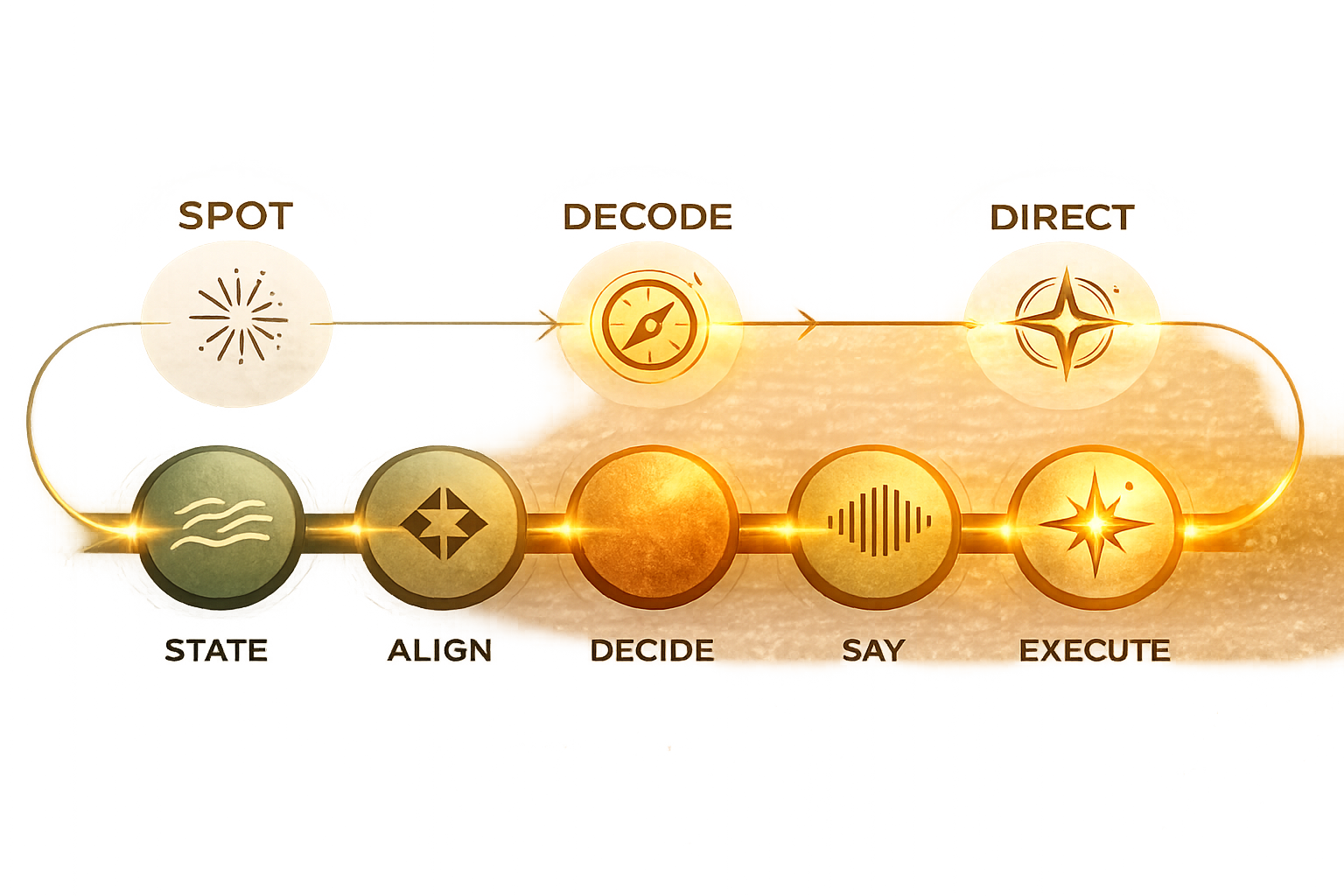
The Spot. Decode. Direct. loop: recognizing your state, understanding what drives it, and choosing your response.
Why this matters now
AI, automation, market volatility and ownership pressure are increasing the cognitive and emotional load on executive teams. The old leadership model — more control, more pace, more output — is reaching its limit.
The next advantage will belong to leaders and organizations that can stay intelligent under pressure.
That means developing the capacity to:
- • Make high-quality decisions in uncertainty
- • Communicate clearly without triggering unnecessary threat
- • Build psychological safety at work without lowering standards
- • Align culture and structure, not treat them separately
- • Sustain transformation without burning out the system
- • Turn pressure into strategic clarity rather than reactivity
This is the work of neuroscience leadership development.
Where BrainShift positions itself
And this is where BrainShift positions itself: as strategic support for executive leaders and organizations navigating complexity.
Not traditional coaching.
Not wellbeing.
Not motivational leadership.
BrainShift is a methodology for increasing decision quality, strategic clarity and transformation capability by connecting neuroscience, leadership behavior, culture and structure to measurable organizational impact.
Final thought
Most leaders do not need more pressure. They need more precision.
They need to understand what happens inside the human system when transformation accelerates. They need to see how their state shapes decisions, how decisions shape behavior, how behavior shapes culture, and how culture either accelerates or blocks execution.
Neuroscience gives leaders a sharper lens.
BrainShift turns that lens into an executive operating system.
Because under pressure, the strongest strategy is not more pressure.
It is strategic presence.
Ready to build strategic presence in your organization?
If your executive team is navigating complexity and pressure, let's explore how neuroscience-based leadership development can increase decision quality and transformation capability.