Inside the Mind of a Neuroscience Coach: What I Teach Leaders About Clarity, Pressure and Change
In a business climate where strategy changes faster than culture can absorb it, coaching is no longer about helping leaders simply "perform better." The real work is deeper. It is about helping leaders understand the nervous system beneath performance, the emotional architecture beneath decision-making, and the invisible patterns that determine whether transformation becomes momentum — or noise.
Most leaders I work with arrive at coaching with a clear problem statement: "I need to be more decisive," or "My team isn't aligned," or "I'm burning out." What they discover in the first few sessions is that the problem isn't the problem. The problem is the nervous system running beneath the problem.
When you understand how your nervous system responds to pressure, uncertainty, and change, everything shifts. You stop fighting yourself. You stop wondering why you know what to do but can't do it when it matters. And you start building the kind of leadership presence that makes transformation stick—not just in strategy documents, but in how your team actually behaves on Monday morning. This is what neuroscience coaching means for leaders—a fundamental shift in how you operate under pressure.
The Gap Between Strategy and Culture
Here's what I see repeatedly in organizations: the strategy is sound. The plan is clear. The business case is solid. But six months in, the transformation stalls. Not because the strategy was wrong, but because the human nervous system—yours and your team's—wasn't prepared for the change.
Change triggers threat. Threat triggers protection. Protection looks like resistance, avoidance, or reverting to old patterns. And when leaders don't understand this dynamic, they often respond by pushing harder—which only increases the threat signal.
The neuroscience is clear: you cannot think your way out of a nervous system response. You cannot willpower your way through it. You cannot strategy your way around it. You have to work with it.
The leaders who move transformation from noise to momentum are the ones who understand their own nervous system first—and then help their teams understand theirs.

Three Pillars of Neuroscience Coaching
My approach to coaching rests on three interconnected pillars. Each one addresses a different layer of how leaders show up under pressure.
1. Nervous System Literacy
You learn to recognize your own threat responses in real time. What does your body do when pressure rises? Do you tighten? Speed up? Withdraw? Go numb? Become people-pleasing? These aren't character flaws—they're survival patterns. Once you can name them, you can work with them.
The outcome: You stop being surprised by your own behavior. You develop choice.
2. Emotional Architecture Mapping
Beneath every decision is an emotional layer rooted in your values and virtues. Fear of failure. Need for control. Desire for approval. Shame about uncertainty. These emotions aren't obstacles to overcome—they're data. They tell you what matters, what you're protecting, and where your leadership presence is strongest.
We all operate with hidden biases—patterns of thinking and perceiving that shape our decisions without our awareness. When you start to see your own hidden biases clearly, you gain the power to decide: do you want to keep them, or do you want to choose differently? This awareness is where real leadership freedom begins.
The outcome: You make decisions from clarity, not from protection. You lead from your values, not from your blind spots.
3. Pattern Interruption and Resilience Building
Once you understand your patterns, we build new ones. Not through willpower or discipline, but through nervous system regulation techniques that actually work under pressure. You learn to stay present when uncertainty is high, to lead from calm instead of from urgency, and to model the kind of clarity your team needs.
The outcome: You become the steady presence that makes transformation possible.
Why This Matters for Transformation Leadership
Transformation isn't a project. It's a shift in how people think, decide, and behave. And that shift only happens when people feel safe enough to let go of old patterns.
As a leader, you set the nervous system tone for your entire organization. If you're in Fight (controlling, pushing, critical), your team goes into protection. If you're in Flight (avoiding hard conversations, staying busy), your team loses direction. If you're in Freeze (overwhelmed, disengaged), your team stops shaping outcomes. If you're in Fawn (people-pleasing, avoiding truth), your team stops trusting you. When leaders need a neuroscience coach is often when these recurring leadership patterns start to limit their effectiveness and their team's potential.
But if you're regulated—present, clear, boundaried, and honest—your team can relax enough to actually change. They can think creatively. They can take intelligent risks. They can align around the new direction because they trust the person leading it. This is what strategic presence under pressure looks like in practice.
- ✓ Clarity under pressure becomes your default, not your exception.
- ✓ Decision-making shifts from reactive to intentional.
- ✓ Team alignment happens because people feel led, not managed.
- ✓ Transformation sticks because it's built on a foundation of nervous system change, not just strategy change.
This is the work I do with C-suite leaders and management teams. It's not about becoming a different person. It's about becoming more fully yourself—the version of you that can lead through complexity, uncertainty, and change without losing your clarity or your humanity.

The Clarity Chain: A Framework for Sustainable Change
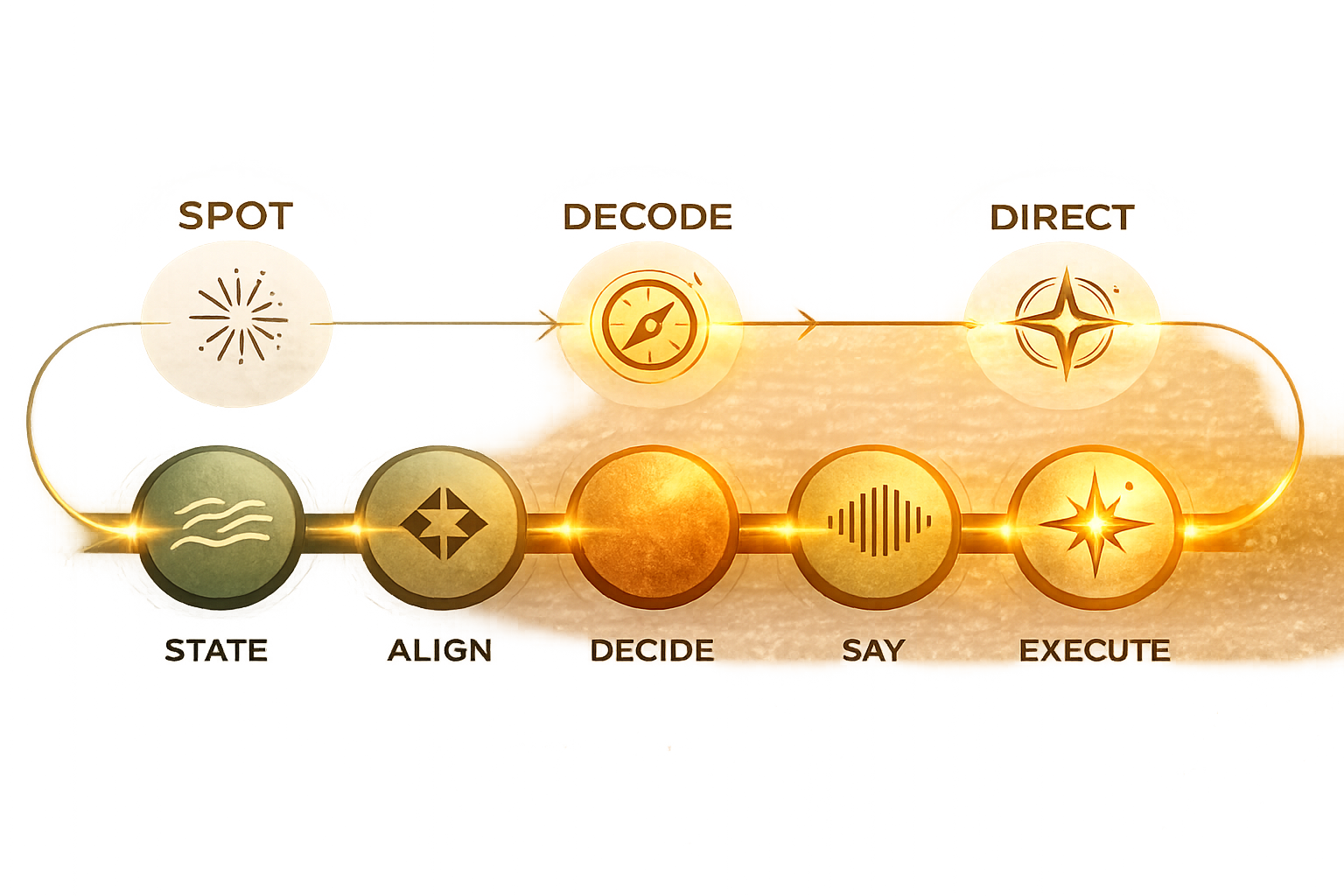
One of the tools I use with leaders is what I call the Clarity Chain. It's a powerful framework that moves you through five essential steps—State, Align, Decide, Communicate, Execute—all run through three core processes: Spot, Decode, and Direct.
State
Recognize your nervous system state in the moment.
Align
Align your internal state with your leadership intention.
Decide
Make decisions from clarity, not from protection.
Communicate
Communicate with presence and authenticity.
Execute
Execute with momentum and team alignment.
Throughout this chain, three core processes run continuously:
Spot
Recognize patterns, threats, and opportunities as they emerge.
Decode
Understand what's really happening beneath the surface.
Direct
Take intentional action aligned with your values and vision.
Most leaders try to fix outcomes at the Communicate or Execute stage—they focus on better messaging or better execution. But the chain breaks earlier. If you can't Spot your state, you can't Align. If you can't Decode what's driving your reactions, you can't Decide wisely. This is why the Clarity Chain works where traditional approaches plateau.
What Happens in a Neuroscience Coaching Engagement
My coaching is structured but deeply personalized. I work with a dual approach: combining traditional business and management coaching with neuroscience and brain-based coaching. This means we address both the strategic and operational layers (goals, execution, accountability) alongside the nervous system and emotional layers (state, presence, resilience). Each phase works at three interconnected levels—individual, team, and organizational—so the transformation ripples through your entire system.
Phase 1: Nervous System Assessment (Weeks 1-2)
We map your threat patterns, your default responses under pressure, and the situations that most dysregulate you. This isn't therapy—it's practical intelligence gathering about how you operate. We also assess your current leadership effectiveness, strategic priorities, and team dynamics to understand the full picture.
Levels: Individual nervous system baseline, team psychological safety assessment, organizational culture patterns.
Phase 2: Emotional Architecture Work (Weeks 3-6)
We identify the core emotions driving your leadership decisions and the values beneath them. What are you protecting? What are you afraid of? What do you need to feel safe? We also work on your hidden biases and how they shape your decisions. Simultaneously, we clarify your strategic vision, priorities, and the leadership behaviors needed to achieve them.
Levels: Your emotional operating system, team communication patterns and alignment, organizational values and culture alignment.
Phase 3: Pattern Interruption and Resilience (Weeks 7-12)
We build new nervous system pathways through regulation techniques that work in real time. You learn to stay present under pressure and lead from calm. We also work on execution strategies, delegation, stakeholder management, and accountability systems to ensure your vision translates into action.
Levels: Your personal resilience and presence, team leadership and psychological safety, organizational change management and execution.
Phase 4: Integration and Sustainability (Weeks 13+)
We embed these new patterns into your leadership practice. You learn to recognize early warning signs of dysregulation and build a personal resilience protocol. We also establish systems for ongoing accountability, feedback loops, and continuous improvement to sustain momentum.
Levels: Your sustainable leadership presence, team culture and engagement, organizational transformation momentum and results.

The Role of the Leader: From Personal Regulation to Organisational Conditions
Neuroscience-based leadership work often begins with the individual leader because the leader's state matters.
A leader under pressure sends signals into the system. Urgency, avoidance, control, silence and emotional reactivity all shape how others interpret the situation.
But the work cannot end with the individual.
The purpose of understanding the nervous system is not simply to become a calmer leader. It is to understand how biology, behaviour and organisational conditions interact.
A regulated leader can make better decisions. But a regulated leader inside an unclear, overloaded or low-trust system will still face friction.
That is why the work must expand from personal awareness to organisational design.
What conditions are we creating for people to think well, decide well and move together?
This is where leadership becomes transformation work.
Collective Clarity Is Different From Communication
Many organisations communicate more when transformation slows.
More town halls. More updates. More slides. More messages.
Sometimes this helps. Often it does not.
The problem may not be a lack of information. It may be a lack of collective clarity.
Collective clarity means the leadership team has a shared understanding of reality, direction, priorities, trade-offs and next steps. It also means that this understanding is translated consistently through the organisation.
Without collective clarity, communication fragments.
One leader emphasises speed. Another emphasises risk. One team hears cost reduction. Another hears innovation. One function believes the priority is stability. Another believes the priority is reinvention.
No one is necessarily wrong. But the system becomes harder to move.
Collective clarity does not require everyone to think the same. It requires leaders to create a shared enough mental model for coordinated action.
This is why leadership teams are often the real transformation bottleneck.
Not because they lack commitment, but because their unspoken assumptions, unresolved tensions and different interpretations create invisible drag. When the leadership team becomes clearer, the organisation receives cleaner signals.
The BrainShift Perspective
BrainShift exists to help leaders understand the hidden human dynamics that determine whether transformation creates momentum or resistance.
It connects business strategy with human behaviour.
The starting point is not: How do we make people change?
The starting point is: What are we observing, what value is being lost, and which conditions are shaping the behaviour we see?
This shift matters because it prevents leaders from jumping too quickly from symptom to solution.
- • Resistance may point to unclear meaning.
- • Silence may point to low psychological safety.
- • Slow decisions may point to cognitive overload or unclear decision rights.
- • Conflict may point to competing priorities.
- • Fatigue may point to too much activity without visible value.
When leaders can read behaviour as information, they stop treating human dynamics as obstacles. They begin to see them as intelligence about the system.
That is where transformation leadership becomes more precise. Not softer. More precise.
From Insight to Movement
The Clarity Chain can be useful when leaders and teams are facing uncertainty, misalignment or pressure.
Before people can move with confidence, they need to understand what is happening, why it matters and what the next step requires.
This does not mean slowing transformation down unnecessarily. It means creating enough clarity to prevent wasted movement.
Many organisations lose time because they act before the system is clear enough to move. They execute into confusion, then spend months repairing misalignment.
Clarity before action is not hesitation. It is preparation for meaningful movement.
The smallest useful question is often: What needs to become clearer before the next decision, conversation or action? That question can reveal where the real friction sits.
The Real Outcome: Transformation That Can Hold
The real outcome of neuroscience-informed transformation work is not simply a more self-aware leader.
It is a leadership system with greater capacity.
- → A system where pressure does not automatically create protection.
- → A system where clarity reduces noise.
- → A system where trust keeps information moving.
- → A system where executive teams can hold complexity without fragmenting.
- → A system where people understand the direction well enough to contribute with intelligence.
- → A system where transformation creates momentum because the human conditions can support the strategy.
This is why the human side of organisational transformation is not separate from business performance.
It is part of how performance becomes possible.
Organisations do not transform because a strategy document says they should. They transform when people understand enough, trust enough and have enough capacity to move together.
That is the shift.
From coaching as individual development to BrainShift as transformation leadership.
- • From pressure to clarity.
- • From activity to value.
- • From alignment in words to alignment in action.
- • From resistance to information.
- • From isolated effort to collective movement.
Successful transformation is not only a question of what the organisation wants to become.
It is a question of whether the organisation has created the human conditions required to get there.
Ready to Lead with Clarity?
If you're a C-suite leader or management team ready to understand your nervous system and lead transformation that sticks, let's talk. A Clarity Call is the first step—no pitch, just a real conversation about where you are and what's possible.