What Is Neuroscience Coaching — And Why Every Leader Needs It in 2026
What is neuroscience coaching, neuroscience and leadership.
How to build leadership capacity for decision-making under pressure in a VUCA economy accelerated by AI integration.
The leadership challenge has changed shape.
A decade ago, the bottleneck was information: access to data, access to expertise, access to best practice. In 2026, the bottleneck is different: human cognition under pressure—how leaders and teams interpret uncertainty, make decisions, communicate, and coordinate action when the environment is volatile, fast, and emotionally charged.
We are moving from "knowing about AI" to integrating AI into daily activity: AI copilots, AI agents, automated workflows, decision support systems. That integration increases speed and optionality. But it also increases noise, complexity, and the psychological cost of uncertainty.
That is why neuroscience and leadership have converged. Not as a trend. As a requirement.
1) What is neuroscience coaching?
Neuroscience coaching is a coaching approach informed by established research on the brain and nervous system. It focuses on what most leadership development often misses:
Leadership is state-dependent performance.
That doesn't mean leaders are "emotional." It means leaders are human. Under pressure, the nervous system shifts, attention narrows, cognition changes, and behavior follows. Neuroscience coaching helps leaders understand—and work with—this reality so they can:
- • Protect cognitive capacity under load
- • Avoid threat-driven decision patterns
- • Communicate without spreading stress into the system
- • Build psychological safety at work (truth surfaces early)
- • Sustain performance without turning urgency into culture
At its best, neuroscience coaching is not brain trivia. It's leadership capability building—so decisions and behavior remain clean when stakes rise.
Want to understand what happens inside the mind of a neuroscience coach? Explore how this approach translates research into real leadership transformation.
2) Why this matters in 2026: The VUCA economy and the AI integration layer
2026 is not just "another year of change." It's an operating environment defined by persistent VUCA:
Volatility
Rapid shifts in markets, geopolitics, energy, supply, regulation
Uncertainty
Less predictable planning horizons, more scenario volatility
Complexity
More interdependencies across tech, people, systems
Ambiguity
More decisions without clear right answers
In that environment, leadership teams are integrating AI at speed. But there's a hidden leadership risk:

The AI paradox: Speed without clarity
AI accelerates output—while compressing reflection
When tools can produce instant drafts, instant analysis, instant options, leaders can mistake speed for clarity. The organisation moves faster, but not necessarily smarter. The nervous system reads this as "high stakes, high pace, low certainty"—and the brain defaults to reactive patterns. Understanding decision-making under pressure becomes critical in this context.
AI increases options—while also increasing uncertainty
More options can feel like more control. In reality, it can increase decision fatigue. The nervous system starts to read the environment as "high stakes, low certainty," and the brain will do what it always does: prioritize safety. This is why, in 2026, leaders must become skilled at creating certainty and safety inside uncertainty—without pretending certainty exists.
Not by "being positive," but by building the conditions where people can think, speak, and coordinate.
3) Your nervous system runs the meeting before you do
Under pressure, leaders tend to default into predictable patterns:
- • Urgency tone and compressed communication
- • Over-control and micromanagement
- • Premature closure ("we don't have time")
- • Conflict avoidance until it becomes escalation
- • Reduced listening and lower cognitive flexibility
This is not weakness. It's biology plus context.
And it affects not only today's performance. It shapes the future.

The generational layer leaders rarely consider
Your nervous system strategies were shaped in a world that likely looked very different from the one you lead in now.
Earlier generations experienced:
- • Different stability expectations
- • Clearer hierarchies and slower change cycles
- • Different norms of authority, risk, and belonging
Those patterns still live in many leaders today as inherited or learned scripts:
- • "Control equals safety"
- • "Certainty equals competence"
- • "Don't show uncertainty"
- • "Keep pushing; recovery is optional"
In 2026, those scripts often create friction and burnout. Neuroscience coaching helps leaders update these internal operating strategies so they match today's reality—so the organisation doesn't pass down "survival cultures" to the next generation of talent.

4) The Clarity Chain: The method inside the work
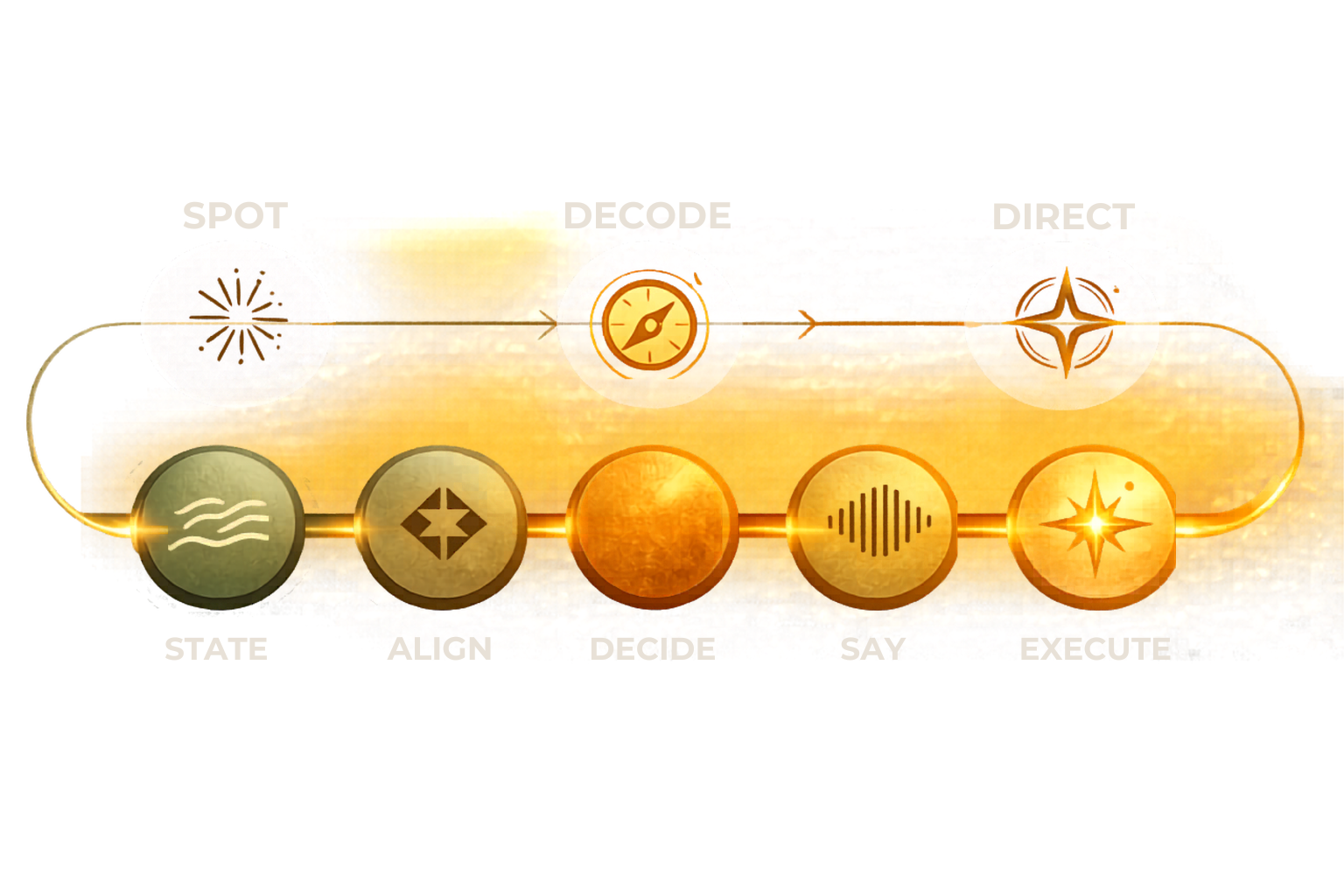
One reason neuroscience coaching becomes practical at executive level is that it provides a repeatable method for moving from internal state to organisational results.
In BrainShift language, clarity moves through five stages:
STATE → Align → Decide → Say → Execute
And inside every stage, leaders use a micro-loop:
SPOT → Decode → Direct
Here's how to understand it at a high level:
SPOT
Learn to recognize signals—breath, tone, muscle tension, pace, attention narrowing—at individual, team, and organisational level
Decode
Identify what the trigger is patterned by—past experience, inherited behavior, learned thought loops
Direct
Choose what to release (patterns that no longer serve) and what to strengthen (patterns that improve outcomes)
This is the difference between insight and capability: not just understanding stress, but being able to lead differently inside it.
5) 2027: The year outcomes become visible
2027 is the year the market can see who integrated AI with maturity.
In 2026, many organisations experimented. In 2027, the difference becomes measurable:
- • Who took bold risks that were anchored in governance and learning loops
- • Who scaled AI without scaling dysfunction
- • Who built sustainable pace instead of permanent urgency
By 2027, "sustainability" in the organisation becomes visible in operational indicators such as:
- • Fewer decision reversals and rework loops
- • Stronger truth flow (risks surfaced early)
- • Higher ownership and lower escalation
- • Steadier execution tempo over time
- • Reduced hidden burnout and presenteeism
These outcomes don't come from AI alone. They come from how leaders and teams use their brain capacity and nervous system capacity under pressure.
The 2027 shift: Treat human capacity the way you treated AI integration
Most leaders approached AI integration with discipline:
- • Readiness assessment
- • Use case selection
- • Governance and guardrails
- • Iteration and improvement
Neuroscience coaching invites the same discipline—but applied to the human operating system:
- • Assess state patterns under pressure
- • Identify the leadership behaviors that protect cognition
- • Build shared language for threat dynamics
- • Embed new defaults into decision forums
Because if you manage AI strategically but ignore human capacity, you scale output and scale dysfunction at the same time.
Why psychological safety becomes a competitive advantage in 2027
The organisations that integrated AI well typically have one advantage: their teams can challenge and learn fast.
That requires psychological safety at work—not comfort, but truth capacity.
When leaders keep the environment safe-to-think:
- • Weak signals surface early
- • Dissent becomes useful rather than dangerous
- • Learning loops stay open
- • Coordination improves across functions
In other words: psychological safety becomes a speed strategy.
6) 2028: The leadership paradigm shift becomes undeniable
By 2028, leadership development has crossed a threshold.
The old paradigm taught models and assumed leaders could apply them under pressure. The new paradigm is research-aligned:
Competence is what you know. Capacity is what you can access when it matters.
This shift is supported by converging research domains:
- • Stress and executive function: Why leaders lose access to cognitive flexibility and inhibition under load
- • Decision-making under uncertainty: Why we seek certainty and simplify under pressure
- • Social threat and collaboration: Why teams stop speaking up
- • Learning transfer and behavior change: Why insight doesn't automatically become habit
- • Organisational psychology: Why systems create predictable patterns
The result: the most valuable neuroscience coaching in 2028 doesn't just explain the brain. It builds a leadership operating system that holds.
Why behavior change requires the nervous system—not only the mind
One of the most important research-informed insights behind the paradigm shift is this:
Most leadership programs fail at transfer because they train cognition but ignore state.
Neuroscience coaching succeeds when it focuses on the mechanisms that make behavior stick:
- • Repetition under realistic conditions
- • Feedback loops tied to real forums (meetings, decisions, conflict moments)
- • Psychological safety for experimentation
- • Reinforcement at identity level ("this is how we lead here")
This is also where Clarity Chain thinking becomes useful: it makes leadership development operational, not inspirational.
7) So what does a "best neuroscience coach" actually mean?
The market is crowded. Many people will claim the label.
The best neuroscience coach is not the one who uses the most brain terminology. It's the one who can change what happens in real leadership situations:
- • In decision forums, where uncertainty spikes
- • In conflict, where tone and threat decide trust
- • In transformation, where alignment breaks easily
- • In leadership teams, where friction either compounds or resolves
How to evaluate (executive-grade)
If you're choosing a neuroscience coach for leaders, use these filters:
Method clarity
Can they explain how they work—what they do in sessions and what changes over time?
Evidence integrity
Do they avoid "brain hacks" and overclaims? Do they use precise language?
Systems relevance
Can they work at individual, team, and organisational level—not only personal insight?
Behavior change under pressure
What shifts should be observable in 8–12 weeks? (decision rework, escalation, truth flow, conflict quality)
Business outcomes
Do they connect neuroscience coaching to decision quality, alignment, execution tempo, and sustainable performance?
This is how neuroscience coaching becomes strategic support—rather than a personal development add-on.
8) Why leaders "need" this now (the simplest summary)
Across 2026–2028, three truths hold:
- • The world becomes more uncertain and complex (VUCA doesn't ease)
- • AI integrates deeper into daily work (speed increases and so does noise)
- • Human cognitive and relational capacity becomes the constraint
Neuroscience coaching is valuable because it protects and strengthens what leaders need most in that environment:
- • Cognitive flexibility to hold complexity
- • Decision quality under pressure
- • Communication that reduces threat
- • Psychological safety at work so teams learn fast
- • Sustainable high performance without survival culture
That's not personal growth as a hobby. That's leadership as a capability.
Where to go next
To deepen your understanding of neuroscience coaching and how it applies to your leadership, explore these related topics:
- • Decision-making under pressure: How state shapes judgment and rework
- • Psychological safety at work: Truth flow as execution infrastructure
- • Sustainable high performance: Presence as capacity, not intensity
If the goal is organisational momentum, a keynote is often the best entry point because it creates shared language quickly—then coaching and advisory embed it into behavior and operating rhythm.
The closing: Why this matters
In 2026, neuroscience coaching helps leaders integrate AI without losing cognitive capacity.
In 2027, it becomes the differentiator between organisations that scale advantage and those that scale dysfunction.
In 2028, it sits at the center of the leadership paradigm shift: from competence to capacity.
Because pressure is a state—not a strategy. And the leaders who can remain clear and human under pressure will build the organisations that last.
Do you recognize yourself in this?
If any of this resonates—if you see the patterns in your own leadership or your organisation—you may be ready for neuroscience coaching. Not because something is wrong. But because the environment has changed, and your operating system needs an update.
Explore signs you need a neuroscience coach to understand if this is the right moment for you.
Ready to explore neuroscience coaching for your leadership?
Understanding the principles is one thing. Experiencing the impact is another. Hanna Curman works with C-suite leaders and organizations to navigate the paradigm shift through neuroscience-informed coaching, team development, and strategic guidance.
Learn more about how Hanna's approach translates neuroscience into measurable leadership outcomes: